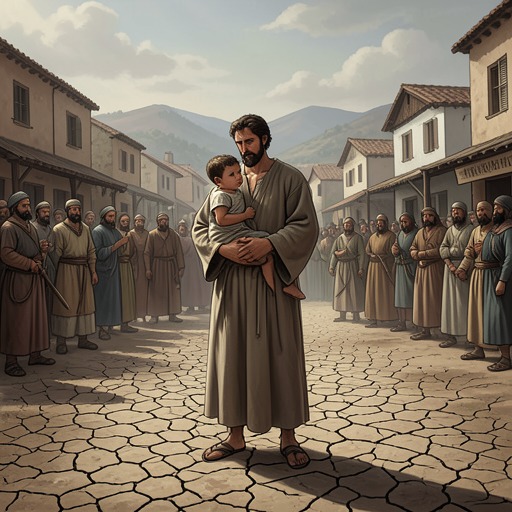
Knecht
The Glass Bead GameKnecht’s final act as the village Rainmaker is to offer himself for sacrifice when his rites no longer bring relief. He ensures that his son Turu is named as successor, then faces the village’s customary judgment without retreating from the duty he believes the crisis demands.
The failed Rainmaker
The village is in despair. Knecht has led processions, sacrifices, and drum ceremonies, but they have not succeeded; villagers threaten and curse him, and after each gathering disperses he is left alone. Ada is gravely ill, as are many others. Maro, the chief of the drum corps and Knecht’s former pupil, has urged the tribal mother to demand the Rainmaker’s death.
Knecht sees the danger to his office and to Turu. He dresses his son in ceremonial robes, brings him to the tribal mother, and proposes him as successor while offering himself as the sacrifice. The tribal mother studies him, then agrees. This is not merely an answer to the village’s demand: Knecht arranges for the office to pass to Turu before the rite can end his own service.
The procession and declaration
The sacrifice takes place that same day. Illness keeps many villagers away, but the tribal mother, two of her oldest sisters, Maro, the village leaders, and the people who can attend join the procession. Turu wears the robes and a tall fox-fur headdress; the heat nearly overwhelms him. The procession reaches a large circular clearing in the woods, a site Knecht himself had selected. Many of the men bring stone axes to gather wood for the funeral pyre.
At the clearing, the leaders form a ring around Knecht, with the larger crowd standing beyond them. When no one speaks, Knecht addresses the people. He recalls his years of service, says that nothing he does now succeeds, and explains that he has offered himself to placate the demons. He names Turu as the new Rainmaker and asks the villagers to obey his son after his death. He then recommends Maro as his executioner.
Maro’s refusal
The tribal mother orders Maro to take the axe and act. Maro stands before his former teacher, raises the weapon, and waits for Knecht to close his eyes. Knecht keeps his gaze fixed on him; its limited expression lies between pity and scorn. Maro cannot carry out the task. He throws the axe away, says that he will not do it, and disappears into the crowd.
The refusal unsettles the ceremony rather than ending it. Some villagers laugh softly, while the tribal mother turns pale with anger at both Maro’s failure and what she sees as Knecht’s arrogance. She calls forward an old man who has known Knecht since boyhood. Unlike Maro, he approaches with a brief, friendly nod.
Succession and death
Knecht closes his eyes and bows his head for the old villager’s blow. Turu, now the new Rainmaker, cannot speak; he gives the necessary instructions by gesture. The villagers build the pyre and place Knecht’s body upon it. Turu’s first official act is the solemn lighting of the fire with two consecrated sticks.
The episode makes succession inseparable from sacrifice. Knecht’s public authority has failed to restore the village’s fortunes, but in its final crisis he acts to protect the continuity of the Rainmaker’s office and to prepare Turu for leadership. His composed acceptance of death stands against Maro’s inability to perform the role Knecht assigns him, while the older villager’s familiar, friendly gesture gives the killing a personal dimension within the communal rite.